
What is RFP shredding?
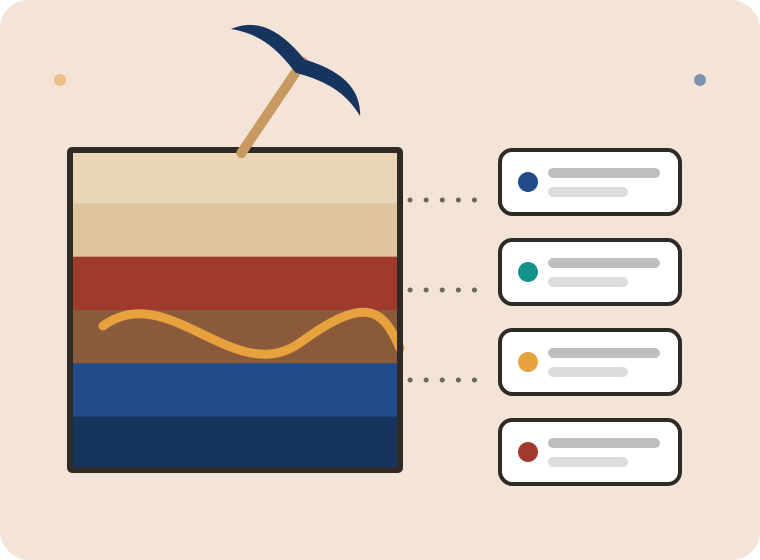
RFP shredding is the process of decomposing a solicitation into its individual, trackable requirements, every "shall," "must," and "will" statement, every submission instruction in Section L, and every evaluation factor in Section M. Done by hand, shredding a 100-page RFP can take a senior proposal manager the better part of a day. It is also where expensive mistakes happen: one missed requirement can make an entire proposal "non-responsive."
How GovHub shreds a solicitation
- Import the solicitation as a PDF, a SAM.gov link, or an agency export.
- GovHub identifies section structure (L, M, C) and extracts every requirement statement.
- Each requirement is tagged with its source section and evaluation relevance.
- The result is a compliance matrix you build the response around.
What to look for in RFP shredding software
Good RFP shredding software does more than search for the word "shall." It recognizes Section L, M, and C structure, captures each requirement in context, and hands you a compliance matrix you can build from. GovHub is RFP shredding software built for government work: it reads a solicitation the way an evaluator does and outputs a structured, exportable matrix.
- It reads Section L instructions, Section M factors, and Section C requirements, not just keyword matches.
- It outputs an editable, exportable compliance matrix, not a flat list.
- It handles PDFs, SAM.gov links, and agency exports.
- It is free to try in your browser, with no login.
Why shredding matters
- Nothing missed: every requirement is captured and trackable.
- Faster start: skip the manual read-and-highlight pass and start drafting sooner.
- Compliance-first: the matrix drives the response outline, so structure follows Section L automatically.
Want to try it now? The free compliance matrix generator shreds pasted RFP text in your browser. For the full workflow (shred, draft, review, and export) see the AI proposal generator.